گیاه پزشکی

گیاه پزشکی

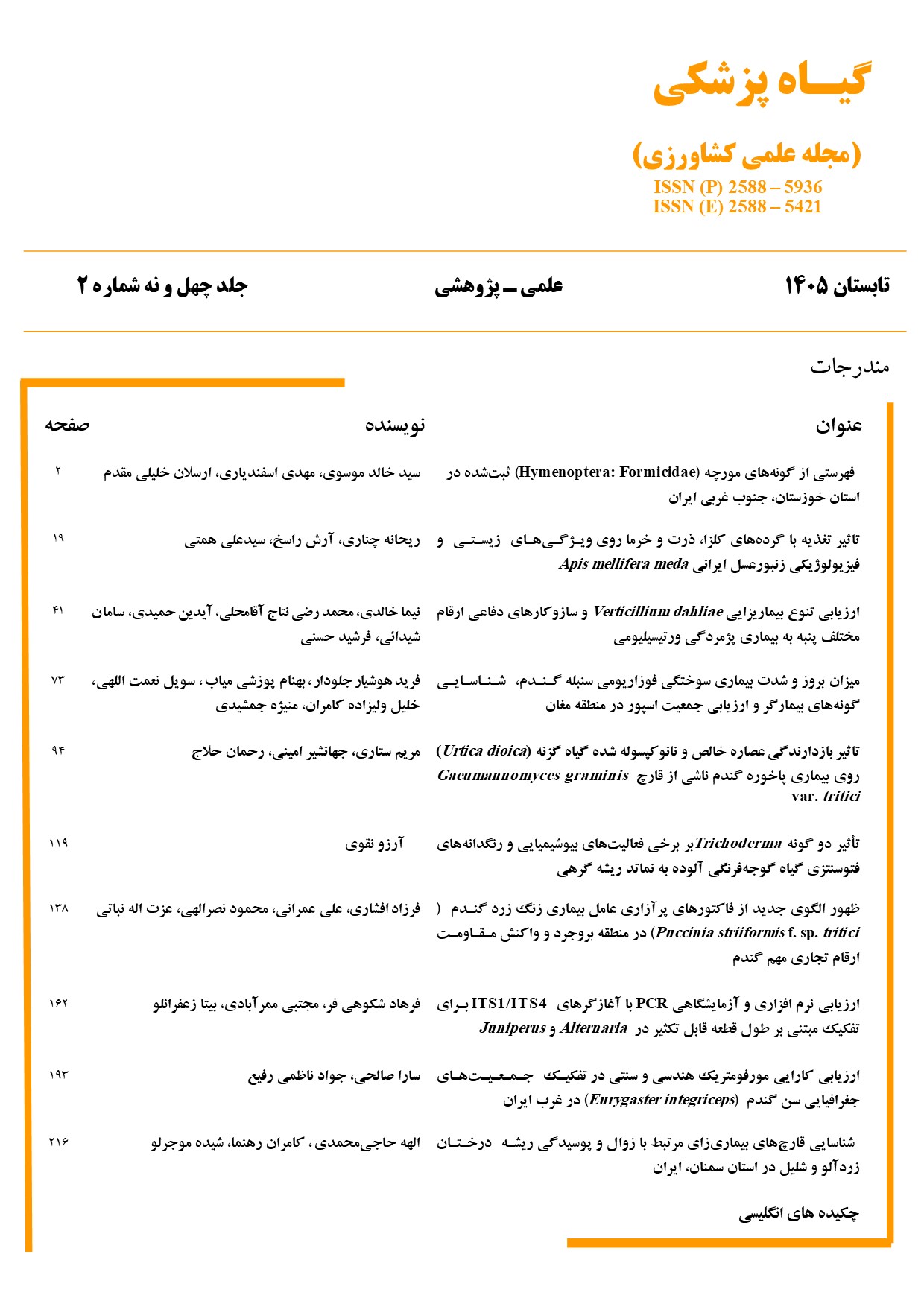
ارزیابی کارایی مورفومتریک هندسی و سنتی در تفکیک جمعیت‌های جغرافیایی سن گندم (Eurygaster integriceps) در غرب ایران

نوع مقاله : علمی پژوهشی-فارسی

نویسندگان
گروه گیاه‌پزشکی، دانشکده کشاورزی، دانشگاه کردستان، کردستان، سنندج ، ایران
چکیده
سن گندم (Eurygaster integriceps) مهمترین آفت گندم و جو در ایران است. هدف از این پژوهش، بررسی تنوع ریختی جمعیت‌های جغرافیایی سن گندم (E. integriceps) و ارزیابی نقش جنسیت در تغییرات اندازه و شکل بدن با استفاده از دو رویکرد مورفومتریک سنتی و هندسی بود. همچنین، کارایی داده‌های پروکراست (مورفومتریک هندسی) و داده‌های باقیمانده (مورفومتریک هندسی) حاصل از حذف اثر اندازه و آلومتری در تفکیک جمعیت‌های جغرافیایی مختلف مورد مقایسه قرار گرفت. 10 شهرستان (سنندج، دهگلان، قروه، ایران‌خواه، مریوان، دیواندره، تازه آباد، سقز، بیجار و کامیاران) از استان کردستان انتخاب شد. تعداد 18 لندمارک بر روی بدن حشرات بالغ نر و ماده با روش مورفومتریک هندسی قرار داده شد. همچنین 9 خصوصیت بدن حشرات بالغ با استفاده از روش مورفومتریک سنتی اندازه‌گیری شد. نتایج تجزیه و تحلیل تابع تشخیص (DFA) با روش مورفومتریک سنتی حشرات ماده و نر نشان داد که تابع تشخیص بر اساس اعتبارسنجی متقابل به ترتیب به میزان 6/30 و 9/27 درصد 10 منطقه نمونه‌برداری استان کردستان را از یکدیگر متمایز نمود. نتایج تجزیه و تحلیل تابع تشخیص (DFA) داده‌های پروکراست (مورفومتریک هندسی) حشرات ماده و نر به ترتیب 3/36 و 9/33 درصد 10 منطقه نمونه‌برداری استان کردستان را از یکدیگر متمایز کردند. همچنین نتایج تجزیه و تحلیل تابع تشخیص (DFA) داده‌های باقیمانده (مورفومتریک هندسی) حشرات ماده و نر به ترتیب 9/42 و 6/39 درصد 10 منطقه نمونه‌برداری استان کردستان را از یکدیگر متمایز کردند. در تحقیق حاضر، دندروگرام حاصل از داده‌های باقیمانده و پروکراست حشرات ماده و همچنین دندروگرام حاصل از داده‌های باقیمانده و پروکراست حشرات نر الگوی گروه‌بندی مشابهی داشتند. تجزیه و تحلیل کلاستر مورفومتریک هندسی نشان داد که دندروگرام حشرات ماده نتایج نسبی بهتری را نسبت به دندروگرام مورفومتریک سنتی حشرات نر وماده و دندروگرام مورفومتریک هندسی حشرات نر نشان داد. به طور کلی، داده‌های مورفومتریک هندسی (داده‌های باقیمانده و پروکراست) در مقایسه با مورفومتریک سنتی، توانایی نسبی بالاتری را در تفکیک گروه‌های جغرافیایی مناطق نمونه‌برداری نشان دادند. همچنین، در تجزیه ‌و تحلیل تابع تشخیص(DFA)، داده‌های باقیمانده در مقایسه با داده‌های پروکراست با استفاده از اعتبارسنجی متقابل، توانایی نسبی بالاتری را در تفکیک جمیعیت‌های جغرافیایی سن گندم (E. integriceps) نشان دادند.
کلیدواژه‌ها
موضوعات

عنوان مقاله English

Assessing the Efficiency of Geometric versus Traditional Morphometrics in Discriminating Geographic Populations of the Sunn Pest (Eurygaster integriceps) in Western Iran

نویسندگان English

S. Salehi
J. Nazemi-Rafie
Department of Plant Protection, Faculty of Agriculture, University of Kurdistan, Sanandaj, Kurdistan, Iran
چکیده English

Background and Objectives
The sunn pest, Eurygaster integriceps Puton (Hemiptera: Scutelleridae), is a major pest of wheat and barley in Iran. Its geographic populations may vary in body size and shape due to environmental conditions and other factors. Traditional morphometrics relies on linear measurements, whereas geometric morphometrics analyzes shape using landmarks. Procrustes-transformed coordinates are widely used in geometric morphometric studies. However, researchers have rarely examined the value of residual shape data, obtained after accounting for size and allometric effects in sunn pest populations. This study compared traditional morphometrics, Procrustes data, and residual data to assess how well each distinguishes geographic populations of E. integriceps in Kurdistan Province, western Iran. It also assessed whether removing size-related effects improves population discrimination and whether the three approaches produce similar clustering patterns. Understanding geographic variation may provide a basis for future studies of population structure and improved pest management.
Materials and Methods
Adult sunn pests were collected from ten counties in Kurdistan Province, Iran: Sanandaj, Dehgolan, Ghorveh, Irankhah, Marivan, Divandareh, Tazehabad, Saghez, Bijar, and Kamyaran. After assessing specimen quality, 30 males and 30 females were randomly selected from each county. The final sample comprised 600 adults: 300 males and 300 females. Nine morphological characters were measured for traditional morphometric analysis. For geometric morphometrics, 18 landmarks were digitized on the dorsal surface of each specimen. Traditional measurements were standardized and analyzed using principal component analysis. We aligned landmark coordinates using Generalized Procrustes Analysis to remove differences in position, orientation, and scale. Centroid size was then calculated. Multivariate regression was used to assess allometry and obtain residual shape data after accounting for size-related effects. We conducted discriminant function analysis (DFA) separately for females and males using each of the three datasets. Classification accuracy was assessed through jackknifed cross-validation. Relationships among the ten geographic populations were also examined using average-linkage clustering (UPGMA) based on Mahalanobis distances.
Results
Discriminant function analysis (DFA) using traditional morphometric data from female and male insects revealed that, by cross-validation, 30.6% and 27.9% of the 10 sampled areas in Kurdistan Province were correctly discriminated for females and males, respectively. Similarly, DFA applying Procrustes data (geometric morphometrics) correctly discriminated 36.3% and 33.9% of the 10 sampled areas for females and males, respectively, based on cross-validation. In addition, DFA using residual data (geometric morphometrics) based on cross-validation correctly discriminated 42.9% and 39.6% of the 10 sampled areas for females and males, respectively. In the present study, the dendrograms generated from the residual and Procrustes data demonstrated similar clustering patterns for both females and males. Cluster analysis based on geometric morphometric data indicated that the dendrogram for females provided relatively better results than the dendrograms generated from traditional morphometric data for both sexes and from geometric morphometric data for males. In particular, Irankhah, Tazehabad, and Dehgolan were grouped with their geographically adjacent regions, Saghez, Divandareh, and Sanandaj, respectively. Furthermore, in DFA, residual data revealed higher discriminatory capacity than Procrustes data for differentiating the geographic populations of the sunn pest (E. integriceps) based on cross-validation.
Discussion
Geometric morphometrics distinguished the sampled geographic populations of E. integriceps more effectively than traditional morphometrics. The higher accuracy obtained with residual data suggests that accounting for centroid size and allometric effects can reveal shape differences that might otherwise be obscured. Residual data provided the highest cross-validated classification rates in both sexes, indicating that they can complement conventional Procrustes coordinates in population-level studies. The similar clustering patterns obtained from Procrustes and residual data also suggest that the main geographic relationships were broadly consistent across the two geometric approaches. Neighboring counties clustered together, matching their geographic proximity. However, classification rates remained below 50%, indicating that morphometric traits alone could not clearly distinguish all ten populations. Future studies could combine broader geographic sampling with independent evidence, such as molecular markers and environmental variables, to better understand the factors underlying population variation. Overall, residual geometric morphometric data provided the best discrimination, followed by Procrustes data and traditional morphometrics.

کلیدواژه‌ها English

traditional morphometrics
geometric morphometrics
residual data
Procrustes data
Eurygaster integriceps
Adams, D. C., Rohlf, F. J., & Slice, D. E. (2004). Geometric morphometrics: Ten years of progress following the ‘revolution’. Italian Journal of Zoology, 71(1), 5–16. https://doi.org/10.1080/11250000409356545
Belintani, T., de Paiva, V. F., de Oliveira, J., & da Rosa, J. A. (2022). New in morphometry: Geometric morphometry of the external female genitalia of Triatominae (Hemiptera: Reduviidae). Acta Tropica, 229, 106383. http://doi.org/10.1016/j.actatropica.2022.106383.
Bookstein, F. L. (1991). Morphometric tools for landmark data. Geometry and biology university press, New York.
Bookstein, F. L. (1998). A hundred years of morphometrics. Acta Zoologica Academiae cientiarum Hungaricae, 44, 7-59. http://doi.org/10.45203/eajbsa.1998.152110
Critchley, B. R. (1998). Literature review of sunn pest, Eurygaster integriceps Put. (Hemiptera, Scutelleridae). Crop Protection, 17, 271–287.  http://doi.org/10.1016/j.aspen.2018.01.016
Daly, H. V. (1985). Insect morphometrics. Annual Review of Entomology, 30, 415–438. http://doi.org/10.1146/annurev.en.30.010185.002215.
Dujardin, J. P. (2008). Morphometrics applied to medical entomology. Infection, Genetics and Evolution, 8(6), 875–890. http://doi.org/10.1016/j.meegid.2008.07.011.
Dujardin, J. P., Kaba, D., & Henry, A. B. (2010). The exchangeability of shape. BMC Research Notes, 3, 266. http://doi.org/10.1186/1756-0500-3-266.
Dujardin, J. P., Steindel, M., Chávez, T., Machane, M., & Schofield, C. J. (2000). Changes in the sexual dimorphism of Triatominae in relation to their evolution. Memórias do Instituto Oswaldo Cruz, 95(6), 837–844. http://doi.org/10.1590/S0074-02762000000600016.
Gere, A., Radványi, D., & Kovács, S. (2023). Recommendations for validating hierarchical clustering in consumer sensory projects. Current Research in Food Science, 6, 100522.
Hammer, O., & Harper, D. A. T. (2006). Paleontological data analysis. Willey-Blackwell, Oxford
Horton, D. R., Unruh, T. R., Lewis, T. M., & Thomsen-Archer, K. L. (2007). Morphological and Genetic Divergence in Three Populations of Anthocoris antevolens (Hemiptera: Heteroptera: Anthocoridae). Annals of the Entomological Society of America, 100(3), 403–412. http://doi.org/10.1603/0013-8746(2007)100[403MAGDIT]2.0.CO;2.
Kamimura, E. H., Viana, M. C., Lilioso, M., Fontes, F. H. M., Pires-Silva, D., Valença-Barbosa, C., Carbajal-de-la-Fuente, A. L., Folly-Ramos, E., Solferini, V. N., Thyssen, P. J., Costa, J., & Almeida, C. E. (2020). Drivers of molecular and morphometric variation in Triatoma brasiliensis (Hemiptera: Triatominae): the resolution of geometric morphometrics for populational structuring on a microgeographical scale. Parasites & Vectors, 13, 455. http://doi.org/10.1186/s13071-020-04340-7
Klingenberg, C. P. (2011). Morphoj: an integrated software package for geometric morphometric. Molecule Ecology Resources, 11(2), 353-357. http://doi.org/10.1111/j.1755-0998.2010.02924
Klingenberg, C.P. (2016). Size, shape, and form: concepts of allometry in geometric morphometrics. Development Genes and Evolution, 226, 113–137. http://doi.org/10.1007/s00427-016-0539-2
Klingenberg, C.P. (2022). Methods for studying allometry in geometric morphometrics: a comparison of performance. Evolutionary Ecology, 36, 439–470. http://doi.org/10.1007/s10682-022-10170-z
Kocorek, A., & Danielczok-Demska, T. (2003). Comparative morphology of the eggs and first instar larvae of European species of the genus Aelia (Hemiptera: Pentatomidae). Zoologischer Anzeiger, 242(3), 205–217. http://doi.org/10.1078/0044-5231-00072
Land, M.F. (1997). Visual acuity in insects. Annual Review of Entomology, 42, 147–177.
https://doi.org/10.1146/annurev.ento.42.1.147
Mehrabadi, M., Bandani, A. R., Saadati, F., & Ravan, S. (2009). Sun pest, Eurygaster integriceps Puton (Hemiptera: Scutelleridae), digestive α-amylase, α-glucosidase and β- glucosidae. Journal of Asia-Pacific Entomology, 12, 79–83. http://doi.org/10.1016/j.aspen.2018.01.016
Miguel, I., Baylac, M., Iriondo, M., Manzano, C., Garnery, L., & Estonba, A. (2011). Both geometric morphometric and microsatellite data consistently support the differentiation of the Apis mellifera M evolutionary branch. Apidologie, 42, 151-166. http://doi.org/10.1051/apido/2010048
Mitra, S., Harsha, R., Hazra, N., & Mazumdar, A. (2014). Estimation of fitness of normal and stylopized paddy pest, Cofana spectra (Hemiptera: Cicadellidae), through correlation of life-history traits. International Journal of Insect Science, 6, 33–42. http://doi.org/10.4137/IJIS.S13029
Mohaghegh, J. (1991). Systematical and biological revision of the genus Eurygaster Lap. In Iran. MSc. Thesis, University of Tehran, Iran. 140 pp.
Nattero, J., Piccinali, R. V., Macedo Lopes, C., Hernández, M. L., Abrahan, L., Lobbia, P. A., Rodríguez, C. S., & Carbajal de la Fuente, A. L. (2017). Morphometric variability among the species of the Sordida subcomplex (Hemiptera: Reduviidae: Triatominae): evidence for differentiation across the distribution range of Triatoma sordida. Parasites & Vectors, 10, 412. http://doi.org/ 10.1186/s13071-017-2350-y
Nazemi_Rafie, J., & Modaber, M. (2025). Residual data reveals greater efficacy than Procrustes data in differentiation and relationships between the populations of Apis cerana (Hym., Apidae). Journal of Asia Pacific Entomology, 28, 1-9. http://doi.org/10.1016/j.aspen.2024.102357
Nazemi-Rafie, J., Modaber, M., & Ghasemi, T. (2025). Residual Data Reveals Greater Efficacy than Procrustes Data in Differentiation and Relationships Between the Populations of Apis florea. Research on Animal Production, 16, 126-137. http://doi.org/10.61882/rap.2024.1480
Özgökçe, M. S., Doğaç, M., & Kara, H. (2025). Molecular phylogeny and population structure of Eurygaster integriceps (Hemiptera: Scutelleridae) in the Southeastern Anatolia Region of Türkiye. Turkish Journal of Zoology, 49(3), 135–147. http://doi.org/10.55730/1300-0179.3219
Popov, C., Barbulescu, A., & Vonica, L. (1996). Population dynamics and management of sunn pest in Romania. In Sunn Pests and Their Control in the Near East (eds Miller, R. H. and Morse, J. G.). Plant Production and Protection, 138, 165-175. http://doi.org/10.1134/S0013873820020050
Rohlf, F. J. (2007). tpsRelw, version 1.45. Department of Ecology and Evolution, State University of New York; Stony Brook, New York, USA.
Rohlf, F. J. (2016). tps Dig2 version 2.17. Department of Ecology and Evolution, State University of New York, Stony Brook, pp 106–117.
Salehi, M.S., Sadeghi, A., Badakhshan, H., & Maroofpour, M. (2018). Evaluation of wheat genotypes for resistance to nymphs of the sunn pest (Eurygaster integriceps Put. [Hemiptera: Scutelleridae]) under field conditions in Kurdistan Province. Plant Pests Research, 7(4), 29–40. https://doi.org/10.22124/iprj.2018.2745
Sarafrazi, A. (2001). Molecular and morphological structures and host associations of the Iranian sunn pest, Eurygaster integriceps (Heteroptera: Scutelleridae) populations.Ph.D. Thesis, University of Wales, Cardiff. 254pp.
Sarafrazi, A., Loxdale, H. D., Hemingway, J., Abdollahi, G., & Murray, D. A. (2004). Host plant associated variation and sexual dimorphism in size and shape in Iranian geographic populations of sunn pest, Eurygaster integriceps Puton. Second International Conference on Sunn Pest, ICARDA.
Sidlauskas, B. L., Mol, J. H., & Vari, R. P. (2011). Dealing with allometry in linear and geometric morphometrics: a taxonomic case study in the Leporinus cylindriformis group (Characiformes: Anostomidae) with description of a new species from Suriname. Zoological Journal of the Linnean Society, 162, 103–130. http://doi.org/10.1111/j.1096-3642.2010.00677.x
Syromyatnikov, M. Y., Golub, V. B., Kokina, A. V., Soboleva, V. A., & Popov, V. N. (2017). DNA barcoding and morphological analysis for rapid identification of most economically important crop-infesting Sunn pests belonging to Eurygaster Laporte, 1833 (Hemiptera, Scutelleridae). ZooKeys, 706, 51–71. http://doi.org/10.3897/zookeys.706.13888.
Zelditch, M. L., Swiderski, D. L., Sheets, H. D., & Fink, W. L. (2004). Geometric morphometrics for biologists: A primer. Elsevier Academic Press. New York and London. 437 pp.
Zibaee, A. (2017). Purification and characterization of a digestive lipase in Eurygaster integriceps Puton (Hemiptera: Scutelleridae). Plant Protection (Scientific Journal of Agriculture), 39(4), 65-78. http://doi.org/10.22055/ppr.2016.12402
 © 2026 by the authors. Licensee SCU, Ahvaz, Iran. This article is an open access article distributed under the terms and conditions of the Creative Commons Attribution-NonCommercial 4.0 International (CC BY-NC 4.0 license) (http://creativecommons.org/licenses/by-nc/4.0/.